Zebra Shades Room by Room in Brownsburg: A Design Playbook
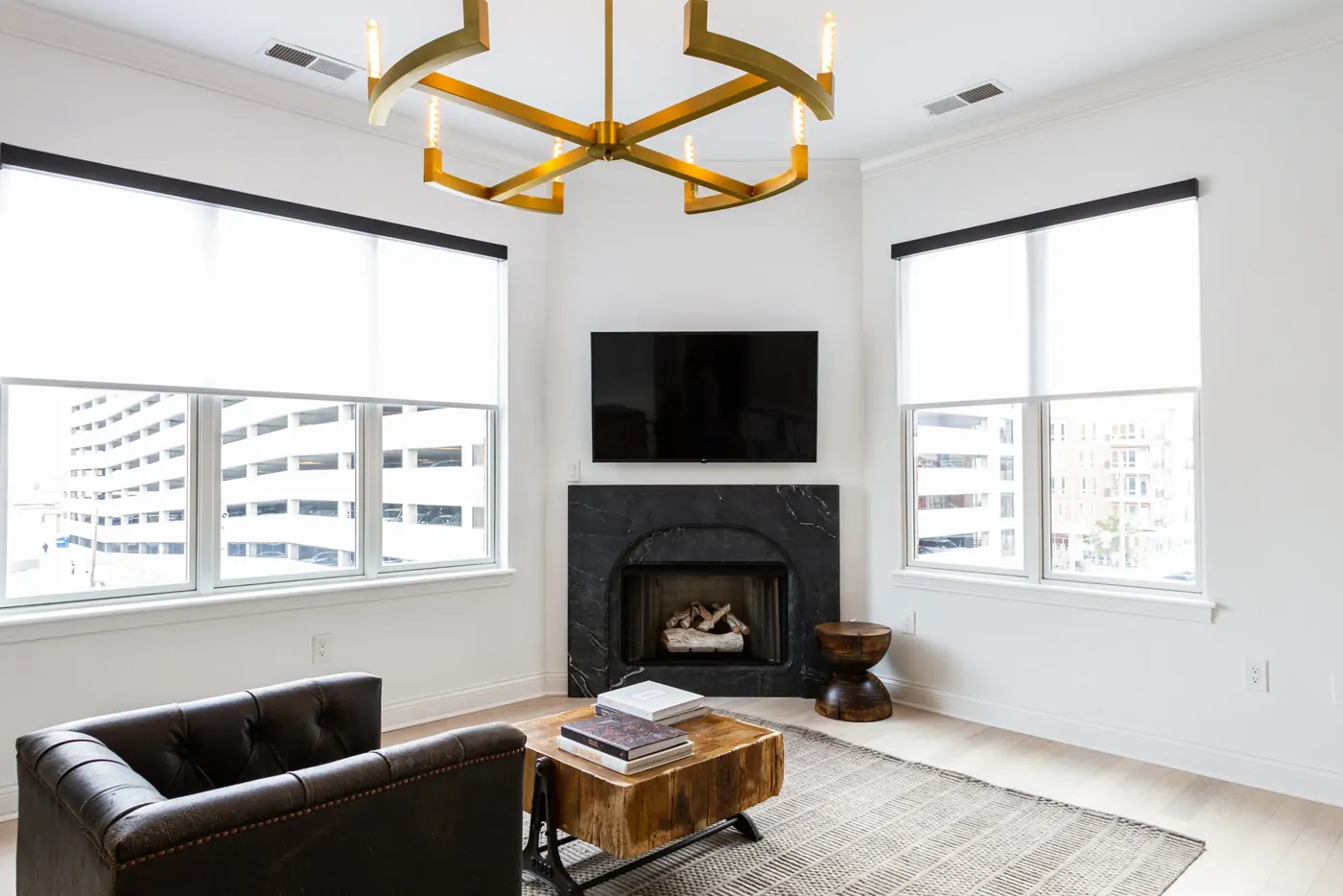
The question we get asked most about zebra shades isn't about fabric or color, it's whether anyone can see in at night. It's a fair question, and the honest answer is more specific than most product pages let on. Here is what actually happens to the view in and the view out, morning through evening, in a Brownsburg home.
How Zebra Shades Work
Before pricing a zebra shade it helps to know what you're actually buying, because the mechanism is what separates this product from a plain roller, and it's also where part of the cost lives. The shade is a single loop of fabric, alternating a solid band and a sheer band, wrapped around one roller tube. As the tube turns, the front layer of the loop slides past the back layer. Align the sheer sections and light and view pass through; align the solid sections and they don't.
Because one tube and one piece of fabric do a job that would otherwise take two separate shades layered on double brackets, a zebra shade is often cheaper to buy and mount than building the same view-then-privacy function out of a sheer roller plus a solid roller. The tradeoff is precision: the bands have to be sewn and wound accurately, and a wider or taller shade puts more strain on the tube and the clutch holding it in position. That's the part of the mechanism a fabric swatch never shows you, and it's exactly what a good measure checks for in a Brownsburg home.
Where Zebra Shades Fit Best Room by Room
Work through a house one room at a time and the fit sorts itself out fast. In a living room or family room, mount the shade high and wide if the trim allows, keep the fabric light to medium in tone, and let the bands kill afternoon glare off a television without losing the view the rest of the day. A kitchen is a good candidate too, except directly behind a cooktop, where grease makes a sheer band a bad idea; a faux wood blind or vinyl roller wipes down easier there.
A bathroom is a maybe. Humidity itself isn't the issue; nighttime privacy is, since a zebra's sheer half always glows a little after dark. A small, high window or one facing a fence is fine as is; one facing a neighbor at eye level does better with a room darkening roller instead. Bedrooms carry the same warning: closed, a zebra dims the room and blocks the view in, but it still glows, so pair it with a drapery panel on a decorative rod if the room needs to go properly dark at night. A Brownsburg home office with glare on a monitor is one of the strongest matches in the house.
Privacy and Light Control: What to Expect
When people compare a zebra shade to blackout curtains or a solid roller shade, this is where the comparison usually breaks down, so it deserves a straight answer. Open, a zebra behaves like a sheer: daylight outside is stronger than the light inside the house, so you see out and nobody sees in. That holds until the sun goes down. Once the lamps are on and it's dark outside, the balance flips, and an open zebra at night lets anyone outside see straight into a lit room.
Closing the bands helps enormously and is genuinely better than leaving any sheer shade open at night. It still isn't equivalent to a blackout shade, because the sheer half of the fabric loop stays sheer no matter how the bands are aligned, so a closed zebra glows softly after dark and shows movement. If full nighttime darkness is the actual goal, a dedicated blackout roller or a lined drape is the right tool, better than expecting the zebra alone to do that job.
Cost, Lift Choices and What Drives the Price
As a national range, stock zebra shades run roughly $60 to $600 a window, a reasonable buy for a rental or a window nobody looks at closely. Nationally, custom shades, measured in the home and installed, run roughly $250 to $2,600 a window, with the spread coming down to fabric weight, tube and clutch quality, how the roll gets covered, and the lift mechanism. A basic polyester band is inexpensive; a heavier woven or light blocking fabric costs more and holds its shape longer.
Lift is where a lot of the price difference lives. A continuous cord loop costs the least but needs its tensioner fastened to the wall or frame every time. Cordless and motorized both cost more from there. Cordless is the safer buy around kids or pets, with cordless product built to ANSI/WCMA A100.1-2022 the one to ask for by name, while motorized is usually the bigger jump and carries its own ongoing cost: battery powered motors nationally run roughly $100 to $300 a window less than hardwired ones, and the batteries need attention about once a year. Custom fabrication typically takes two to five weeks.
Price a zebra shade the way you'd price any custom order: per window, in writing, with the fabric and lift named on the line. That habit alone makes two bids comparable. Brownsburg Window Treatments works from national ranges and quotes your actual openings rather than a guess off the wall. Call (317) 999-5154 in Brownsburg and we'll put the numbers on paper.
Measuring, Mounting and Care
Here's where measuring mistakes actually surface. If an inside mount cassette needs roughly two and a half to three inches of flat depth and the trim only offers two, the cassette sits proud of the frame instead of flush, and there's no fixing that after the fact except switching to a bracket only mount or building the trim out. Square is the other one that bites people. A lot of older Brownsburg houses have an opening that's shifted slightly over the years; a shade cut to the narrow number leaves a visible wedge of light down one side once it's hung.
Even a perfect measure leaves a gap at the edges of an inside mount, usually close to three quarters of an inch per side by the time bracket hardware is added in, and that's expected, not a defect. As for care, the fastest way to damage a zebra shade is to scrub the sheer band or run it through a washing machine. Vacuum with a soft brush on low suction, spot clean with a barely damp cloth, and if a seam between a solid and sheer band starts to separate, stop and get it repaired before it runs any further.
Frequently Asked Questions
Are zebra shades better than solar shades?
They do different jobs. A solar shade has one fixed openness, so it controls glare and keeps some view all day without ever giving you privacy. A zebra changes from view-through to closed in about one band of travel, so one shade covers both needs. Solar shades win on very wide openings and on windows where you never want to lose the view. Zebras win in rooms where the demand changes between afternoon and evening.
How much mounting depth does a zebra shade need?
For a flush inside mount with a cassette, plan on roughly two and a half to three inches of flat depth behind the front edge of the trim. Bracket-only mounts need considerably less, but the roll stays visible from below. If your opening is shallow, the usual answers are an outside mount over the trim or a reverse roll that clears the obstruction. We measure depth at the measure and tell you which options your opening supports.
How long do custom zebra shades take?
Two to five weeks is normal from the day the order is placed, depending on the fabric and the factory queue. Motorized shades sometimes run at the longer end because the motors are ordered separately. Nothing in this trade is urgent, so use the wait to get the room painted or the furniture placed. If a company promises you custom shades next week, they are almost certainly quoting stock sizes rather than made-to-measure.
 The Brownsburg Homeowner's Guide to Blind and Shade Repair
 Pleat Styles, Fullness and Lining for Brownsburg Drapery Orders
 When Stock Blinds Are the Right Call in a Brownsburg Home